The executive, who has been on the carrier’s board since October 2010, earned a base salary of S$1.46 million, or 15% of his total pay package, according to the firm’s annual report released on Thursday.
He received around S$4.75 million, or 49% of his remuneration, in shares and S$3.34 million (35%) in bonuses.
Goh’s pay package included conditional shares granted last July for the airline’s FY2024/2025 performance under a long-term share incentive scheme introduced during the Covid-19 pandemic to retain and motivate key executives, The Straits Times reported.
The scheme is being phased out and the overlap between the final award under the program and grants from SIA’s existing share plans led to a temporary surge in share-based compensation.
 |
|
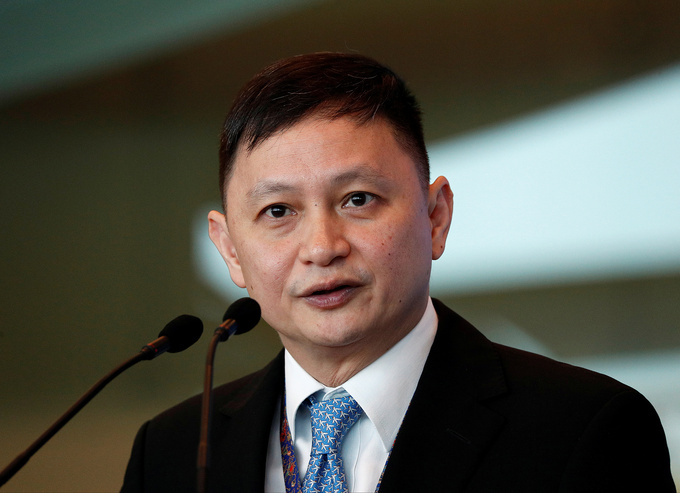
Singapore Airlines CEO Goh Choon Phong speaks before a tour of Singapore Airlines’ A380 fitted with newly launched cabin products at Changi Airport in Singapore Dec. 14, 2017. Photo by Reuters |
Chief commercial officer Lee Lik Hsin and chief operations officer Tan Kai Ping each received between S$3.75 million and S$4 million in remuneration, including the strategic share award.
Pay for non-executive directors ranged from S$160,830 to S$824,610, with chairman Peter Seah Lim Huat receiving the highest pay.
Singapore Airlines reported a net profit of S$1.18 billion for the year, down 57% from a year earlier, despite posting a record revenue of S$20.5 billion and a 39% increase in operating profit to S$2.4 billion.
Nonetheless, the result still exceeded the S$1.08 billion analysts had expected and came as a positive surprise despite a sizable impairment linked to the airline’s stake in Air India, according to Bloomberg.
Chairman Seah said in the annual report that airlines have faced rising geopolitical tensions, macroeconomic uncertainty and continued supply chain disruption over the last year.
The conflict in the Middle East also pushed up jet fuel prices, Singapore Airlines Group’s biggest expense, adding to inflationary pressures and operational uncertainty. But demand for air travel remained robust, with the airline carrying a record 42.2 million passengers during the year, he noted.
“The Group’s nimble response to the Middle East conflict bucked the broader industry trend of shrinking capacity and networks,” he added.
Sourcee.vnexpress.net